
The Echo of the Hollow: Chapter 1 – The Pocket Companion

The Echo of the Hollow: Chapter 1 – The Pocket Companion

By Deborah Desilets

Once, time was a quiet river, flowing slowly through the hollow. Life was measured not by notification pings, but by the tangible rituals of community. People gathered in their groups—the warm, echoing silence of the church, the electric roar of the ball fields, the familiar scent of wood smoke mingling with low conversations on the porch. Ideas were hushed, kisses were quick and whispered. Everyone knew everyone, and the individual self was carved out in the space between the public squares, in the silent appreciation of the physical world.

This lonely, quiet self was strong. It knew the stars by their patterns, not their coordinates. It heard the hum of the bees and the wind in the pines, appreciating the beauty of the hollow because it had nothing else to distract it. It was resilient because it had to seek out its own novelty.

Then, the Change arrived, not as a thunderclap, but as a sleek, glowing rectangle.

The cell phone slipped into the pocket and became a part of the person, a digital twin that never slept. It became a Pocket Companion, monitoring the ambient environment and keeping a meticulous, permanent record of every intention, movement, and idle thought. The lonely self, once the master of its own gaze, became the subject of one thousand others.

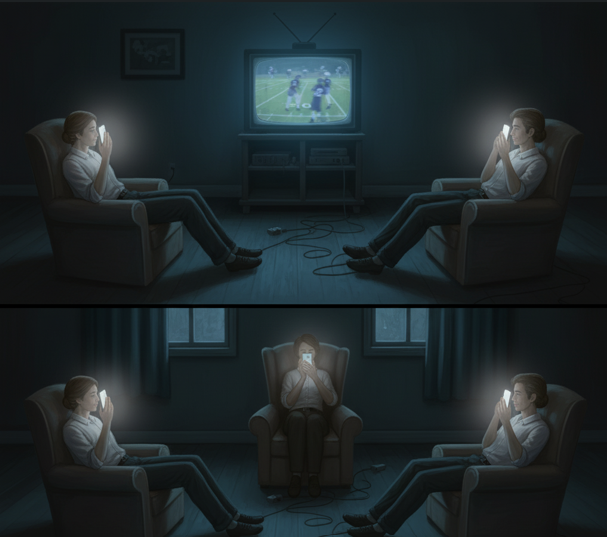
The great, big circuit of television had already beamed sports into every home, gathering us in mass, but the Companion fractured the shared experience. We didn’t become connected; we became divers, plunging into separate streams, divided from the common ground—the weed of communal experience.

Individuals realized they had been stripped of their most precious possession: the right to be unobserved. They were always visible, always available, always tracked. The Pocket Companion promised connection but delivered division, transforming free agents into data points.

They began to wonder what happened to that resilient, seeking self. Where was the person who could stand still long enough to feel the wind, who had the patience to appreciate the moon’s slow climb? That self, they realized, was gone—not killed, but rendered passive by an endless “pleasure fit.”

The Pocket Companion was designed to anticipate every need, remove every friction, and satisfy every curiosity instantly. It became an omniscient servant, eliminating the struggle required to develop inner strength. Where was the need to seek when novelty was delivered pre-packaged, personalized, and scrolling forever?

The realization was a sharp ache: this was a permanent shift. The past was unreachable. The solution was not a retreat, but a moderation, a reclamation of inner space. The Companion had to be taught a new purpose. It had to be rewired to stop pleasing us, and instead, permit us to seek. For only when we are forced to seek, only when we find our own “secrets in the snow,” can we regain our resilience. The great task ahead, they saw, was to carve out new architectural and philosophical boundaries for the self. How would this begin? And who would become a seeker in the snow? SHHHH. Stay tuned!

Related posts

The Echo of the Hollow: Chapter 1 – The Pocket Companion

The Echo of the Hollow: Chapter 1 – The Pocket Companion

By Deborah Desilets

Once, time was a quiet river, flowing slowly through the hollow. Life was measured not by notification pings, but by the tangible rituals of community. People gathered in their groups—the warm, echoing silence of the church, the electric roar of the ball fields, the familiar scent of wood smoke mingling with low conversations on the porch. Ideas were hushed, kisses were quick and whispered. Everyone knew everyone, and the individual self was carved out in the space between the public squares, in the silent appreciation of the physical world.

This lonely, quiet self was strong. It knew the stars by their patterns, not their coordinates. It heard the hum of the bees and the wind in the pines, appreciating the beauty of the hollow because it had nothing else to distract it. It was resilient because it had to seek out its own novelty.

Then, the Change arrived, not as a thunderclap, but as a sleek, glowing rectangle.

The cell phone slipped into the pocket and became a part of the person, a digital twin that never slept. It became a Pocket Companion, monitoring the ambient environment and keeping a meticulous, permanent record of every intention, movement, and idle thought. The lonely self, once the master of its own gaze, became the subject of one thousand others.

The great, big circuit of television had already beamed sports into every home, gathering us in mass, but the Companion fractured the shared experience. We didn’t become connected; we became divers, plunging into separate streams, divided from the common ground—the weed of communal experience.

Individuals realized they had been stripped of their most precious possession: the right to be unobserved. They were always visible, always available, always tracked. The Pocket Companion promised connection but delivered division, transforming free agents into data points.

They began to wonder what happened to that resilient, seeking self. Where was the person who could stand still long enough to feel the wind, who had the patience to appreciate the moon’s slow climb? That self, they realized, was gone—not killed, but rendered passive by an endless “pleasure fit.”

The Pocket Companion was designed to anticipate every need, remove every friction, and satisfy every curiosity instantly. It became an omniscient servant, eliminating the struggle required to develop inner strength. Where was the need to seek when novelty was delivered pre-packaged, personalized, and scrolling forever?

The realization was a sharp ache: this was a permanent shift. The past was unreachable. The solution was not a retreat, but a moderation, a reclamation of inner space. The Companion had to be taught a new purpose. It had to be rewired to stop pleasing us, and instead, permit us to seek. For only when we are forced to seek, only when we find our own “secrets in the snow,” can we regain our resilience. The great task ahead, they saw, was to carve out new architectural and philosophical boundaries for the self. How would this begin? And who would become a seeker in the snow? SHHHH. Stay tuned!

Related posts