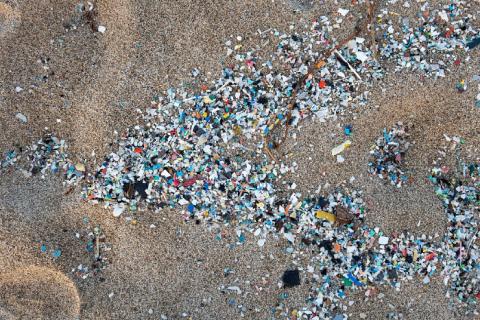
Micro plastic pollution affects dolphins off the coasts of Florida and Louisiana
A team of scientists detected that in the breath exhaled by bottlenose dolphins there were PET particles, small fragments of this plastic that are commonly used in bottles and containers
By Evaristo Lara, Huella Zero
The production and use of plastics together with poor disposal management has generated such extreme pollution that it is possible to find residues of this petroleum byproduct both at the top of the world, in the snowy peaks of Mount Everest, in Asia; and in the Mariana Trench, in the Pacific Ocean, the deepest point on the planet.
This material, developed just over a century ago to make life more comfortable for humans, has ended up becoming a threat to the health of the species that inhabit the planet. This was concluded by a study initially published in the journal PLOS ONE.
The research was led by Leslie B. Hart, co-director of the Center for Coastal Environmental and Human Health at the College of Charleston, in South Carolina; and by Miranda K. Dziobak, a biochemist at the College of Charleston.
Both researchers were curious about what kind of contaminants they could find in the body of a living dolphin. To determine this, they decided to perform a breath test on some of these marine mammals that live off the coasts of Florida and Louisiana, where these specimens tend to be friendlier with people.
After collecting breath samples from 11 dolphins, they put them under a microscope and identified particles with characteristics typical of plastics. They then used a welding needle to check if the particles melted when heated—as plastic does—and it turned out that they did. The next step was to use a laser to identify the specific chemical components of the particles.
In this way, they confirmed the presence of 54 micro plastics in the dolphins’ breath samples, several of them linked to polyethylene terephthalate (PET) – a material used to make soda, juice and water bottles – and polyester, a component that comes off clothes when they are used or washed.
The finding suggests that these marine mammals breathe micro plastics when they come to the surface to get air, which could cause damage to their lungs; but determining the degree of affectation would be the subject of further studies.
Micro plastics in other mammals
The presence of micro plastics in humans and rodents is not only documented, but the negative effect it has on the respiratory health of mammals, caused by inhaled or ingested plastic, has also been demonstrated. Experts have reported cases of inflammation and oxidative stress in the lungs and airways. Therefore, the case of dolphins could be just the tip of the iceberg that will allow us to discover other species of marine fauna also affected by exposure to micro plastics.
As a precautionary measure, experts such as Chilean Catalina Droguett, eco-journalist and pioneer in the defense of sustainability, recommend avoiding the use of plastic products, especially single-use ones.
“Every year, 400 million tons of plastic are produced and half of them are disposable containers, cups, etc. These are products that will last more than 400 years and are used in just minutes. We must make conscious decisions and have governments that make consensual decisions regarding the environment,” she said.