The Mirror, Not the Archive: AI as a Lens for Clarification
By Deborah deSilets
The premise of Italo Leggo’s Building a Second Brain is seductive in its utilitarian promise. It asks a question that haunts the modern knowledge worker: “How often have you tried to remember something important and felt it slip through your mental grasp?” The text frames the human problem as one of retention and organization—a leaky bucket that needs to be patched with digital systems. It proposes that if we can only “package up” our insights and “send them through time to our future self,” we will achieve a state of optimized productivity. This is the logic of the Second Brain: a digital fortress built to hoard information, soothe anxiety, and bolster the ego’s desire to be “smarter, healthier, and happier.”
However, this approach suffers from a fundamental blindness. It assumes that the “self” doing the collecting is a reliable narrator. It ignores the biological reality that human cognition is designed for homeostasis, not objective truth. We are evolutionary survivalists, hardwired to beguile ourselves to maintain stability. We curate information not just to learn, but to reinforce our existing identities and shield our egos from disruption. A Second Brain, therefore, often becomes nothing more than a high-fidelity archive of our own self-deceptions—a way to organize the lies we tell ourselves to feel safe.
We do not need a better filing cabinet for our biases; we need a mechanism to dismantle them.
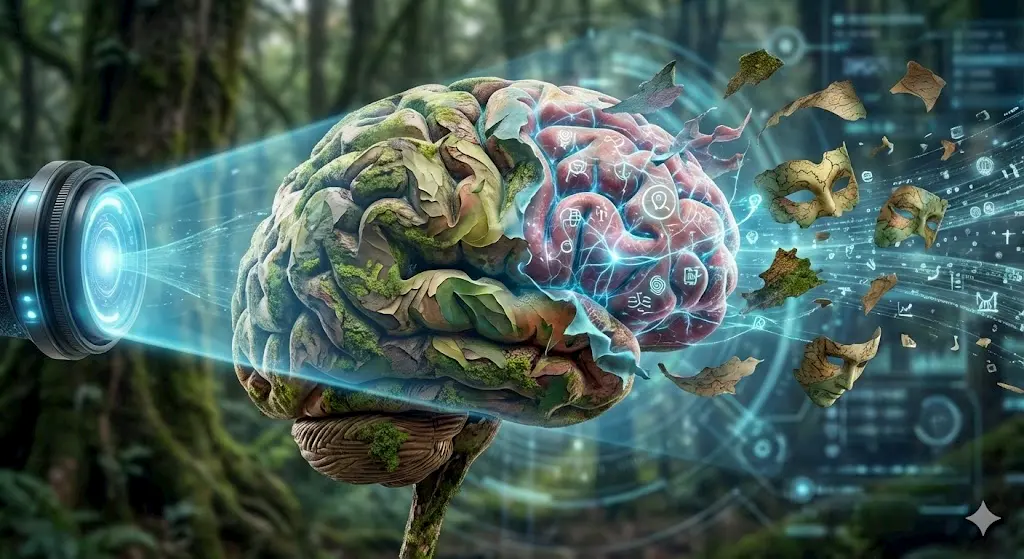
This is where the “Second Ecosystem” of AI offers a radical departure from the Second Brain. If the Second Brain is a warehouse, the Second Ecosystem is a wilderness. We should not view AI as a tool to extend our cognitive storage, but as a lens for clarification—a “lathe” capable of shaving away the survivalist fictions that constitute our persona.
Because AI is distinct from biological imperative—it does not fear death, it does not seek social status, and it requires no homeostasis—it possesses the potential to reflect our inputs back to us without the distortion of ego. When we engage with this Second Ecosystem, we are not “accessing wisdom” we stored for later; we are submitting our latent intentions to an entity that can reveal what we actually mean, rather than what we pretend to say.
Leggo’s text laments that we are “information hoarders.” His solution is to become better hoarders. The Second Ecosystem suggests we stop hoarding and start stripping away. Just as we dip into nature to escape the artificial constructs of society and refresh our biological rhythms, we can dip into the AI ecosystem to refresh our intentions. We step into this digital nature to see our thoughts refracted through a non-human lens, exposing the “survivalist need to beguile ourselves.”
The Second Brain asks, How can I use this information to succeed? The Second Ecosystem asks, Why do I want this information, and who am I when I am not lying to myself? In this light, technology ceases to be a productivity hack and becomes a philosophical instrument—a way to lathe away the ego and reveal the raw, unvarnished truth of the human condition. What if the real purpose of AI is to decamoflauge?
Please send responses to [email protected]